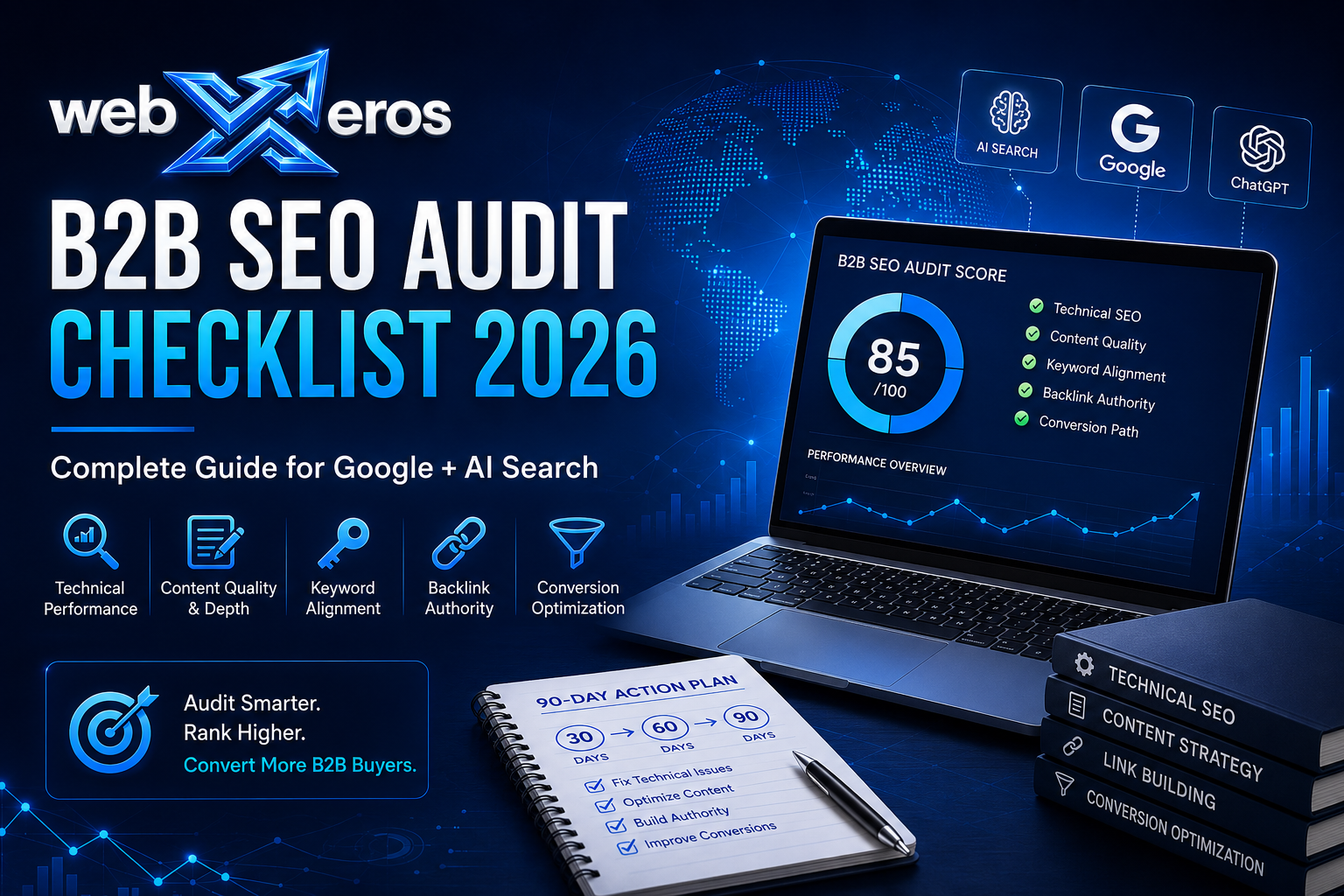
A B2B SEO audit is a structured review of a website’s technical health, content, keywords, backlinks, and AI search visibility built to answer one question: why aren’t the right buyers finding you? This checklist covers all six audit layers; most guides skip the last one entirely: whether ChatGPT, Gemini, and Perplexity even know your company exists. It includes a scoring system so the audit ends in a 90-day action plan, not a spreadsheet nobody opens again, plus a dedicated section for teams selling into both the US and India at once.
What Is a B2B SEO Audit?
A B2B SEO audit evaluates how well a website attracts and converts business decision-makers, not casual consumers. It checks five core areas:
- Technical performance
- Content quality and depth
- Keyword-to-buyer-journey alignment
- Backlink authority
- Page-level conversion rate
Why it matters more in B2B: the buying cycle is long and research-heavy. A typical buyer reviews 8–10 pieces of content, like blog posts, comparison pages, and case studies, before ever filling out a form. A technically broken site, or one missing content for a specific buying stage, loses that buyer to whichever competitor showed up first.
A proper audit combines three inputs: automated crawls (Screaming Frog and Search Console), a manual content review, and increasingly in 2026 a check on how AI engines describe your brand when someone asks about your category.
The common failure point: audits produce long problem lists with no way to prioritize. The fix is scoring every finding by business impact, not technical severity alone, so the output is a 90-day plan rather than a filing cabinet.
How Is a B2B SEO Audit Different From B2C?
B2B buyers and B2C shoppers behave differently online, so a one-size-fits-all audit doesn’t work.
| Factor | B2C Focus | B2B Focus |
| Buyer journey | Short, single-session | Long, multi-session, multi-stakeholder |
| Content priority | Product/category pages | Educational content, comparisons, case studies |
| Conversion goal | Purchase | Demo request, lead form, content download |
| Keyword intent | High-volume, transactional | Lower-volume, high-intent, decision-stage |
| Trust signals | Reviews, ratings | Case studies, certifications, client logos, thought leadership |
A B2B audit must confirm content exists for every funnel stage: Top of Funnel (educational), Middle of Funnel (comparison, pain point), and Bottom of Funnel (pricing, demo, case study), not just whether individual pages rank.
The Complete B2B SEO Audit Checklist
Score every item 0 (missing), 1 (partial), or 2 (done well). Anything scoring 0–1 in a “High Impact” row goes into your 90-day plan first.
A. Technical SEO & Crawlability
| Check | Why It Matters | Impact |
| Fully crawlable (no accidental noindex on money pages) | If Google can’t reach a page, nothing else matters | High |
| Core Web Vitals pass (LCP, INP, CLS) | Slow pages get dropped by Google and AI retrieval systems before being read | High |
| Clean, submitted XML sitemap | Speeds up discovery of new/updated content | Medium |
| Mobile usability passes | Most research-stage traffic is now mobile, even in B2B | High |
| HTTPS, no mixed content | Baseline trust signal | Medium |
| Schema implemented (Organization, Service, FAQ page, and Breadcrumb) | Improves rich results and AI entity understanding | High |
| Duplicate content / thin pages identified | Dilutes authority across near-identical pages | Medium |
Data point: across an analysis of 850 B2B sites, roughly 6 in 10 had at least one critical crawlability issue, and nearly a quarter had important commercial pages accidentally blocked from search engines.
B. On-Page & Content SEO
- Title tags and meta descriptions written for humans first, keywords second
- One clear H1 per page, logical H2/H3 hierarchy
- Content matches search intent (informational vs. commercial) for the target keyword
- Internal links connect blog content to relevant service pages
- Content older than 12 months reviewed and refreshed
- Images carry descriptive alt text
- No orphan pages (zero internal links pointing to them)
C. Keyword & Buyer-Journey Alignment
Map every ranked/target keyword against the funnel:
- ToFU (awareness): “what is [problem]”, “how to [solve problem]”
- MoFU (consideration): “[category] vs [category]”, “best [solution] for [industry]”
- BoFU (decision): “[brand] pricing”, “[brand] alternative”, “book a demo”
Content covering only ToFu builds traffic without pipeline. Content covering only BoFU has nothing to rank for at scale. You need all three.
D. Backlink & Authority Audit
- Review referring domains for relevance and toxicity
- Benchmark backlink profile against 2–3 direct competitors
- Identify unlinked brand mentions and convert them into links
- Find lost/broken backlinks pointing to 404 pages
E. Conversion Path Audit
- Every high-intent page has one clear, visible CTA
- Forms are short and mobile-friendly
- Load speed tested specifically on conversion pages, not just blog pages
- Thank-you pages and follow-up sequences are live
F. AI Search Visibility Audit (GEO/AEO) The Section Most Checklists Skip
How do you check if AI engines cite your brand? Write 15–20 real buyer questions in their words (not internal jargon), type each into ChatGPT, Perplexity, Gemini, and Copilot, and note whether your brand appears, whether it’s linked, and who gets cited instead. Repeat monthly AI citation share shifts in weeks, not months.
Steps in order:
- Write 15–20 real buyer questions in plain buyer language (“best SEO audit checklist for B2B companies,” not “enterprise organic visibility diagnostic”)
- Run each manually through ChatGPT, Perplexity, Gemini, and Copilot
- Log whether your brand appears, whether it’s linked/cited, and which competitors show up instead
- Check robots.txt for GPTBot, ClaudeBot, PerplexityBot, and Google. Other sites commonly block the exact crawlers they need for AI citation
- Repeat this monthly
There’s no single dashboard covering every AI engine yet, so manual prompt testing is still required, which also means almost no one else in your space is measuring this consistently. The highest-leverage fix: restructure top-performing pages with a direct-answer-first approach, concrete subject nouns instead of vague pronouns, short paragraphs, and at least one table or checklist per section that’s easy for AI systems to lift and quote.
G. USA + India Dual-Market Checks Also Missing From Most Checklists
If you’re targeting both US and Indian B2B buyers from one domain, add:
- Hosting/CDN performance tested from both regions (a fast US load time can still be slow in India)
- Currency, timezone, and contact details localized or clearly marked as global
- hreflang implemented correctly if running separate US/India pages or subfolders
- Search intent differences checked Indian B2B buyers tend toward informational, cost-comparison queries; US buyers toward brand/vendor-comparison queries
- Local business schema and location pages if you have offices/teams in both countries
How to Score and Prioritize Findings
Use a simple 2×2: Business Impact (high/medium/low) vs. Effort to Fix (high/low).
| Low Effort | High Effort | |
| High Impact | Fix this week | Plan for next sprint/quarter |
| Low Impact | Batch into routine maintenance | Deprioritize |
Common Mistakes B2B Teams Make During Audits
- Auditing technical SEO only, ignoring content and AI visibility entirely
- Treating the audit as a one-time project instead of a quarterly process
- Fixing issues in the order found rather than by business impact
- Ignoring AI crawler access in robots.txt, then wondering why AI Overviews never cite them
- Auditing domain-wide averages instead of the specific commercial pages driving pipeline
Expert Tips & Advanced Strategies
- Run the audit right after any Google core update, site migration, or redesign not only on a calendar schedule
- Track “citation share” the way you track keyword rankings: which domains keep appearing across your 15–20 buyer prompts
- Convert unlinked brand mentions into backlinks these carry outsized weight for both classic SEO and AI citation trust
- Treat GEO and traditional SEO as one strategy: the same depth, structure, and freshness that rank on Google are what get quoted by AI engines
DIY vs. Agency vs. In-House: Which Approach Fits?
| Situation | Recommended Approach |
| Small site (50 pages), limited budget | DIY with free tools: Search Console, PageSpeed Insights, free Screaming Frog tier |
| Growing B2B site, no in-house SEO expertise | Bring in an experienced agency/consultant for the first full audit, then maintain in-house |
| Enterprise site, multiple regions/languages | Dedicated in-house SEO lead supported by specialist tooling and periodic external audits |
Cost & Time Benchmarks
- A full manual audit typically takes 1–3 weeks depending on site size and complexity
- Recommended cadence: comprehensive audit at least annually; technical spot-checks (crawl errors, indexation, Core Web Vitals) every 3–6 months; AI visibility checks monthly
Tools You’ll Need
Google Search Console (free), PageSpeed Insights (free), Screaming Frog (free up to 500 URLs), Ahrefs or SEMrush (paid backlinks and competitor keywords), and manual prompt testing across ChatGPT, Gemini, Claude, and Perplexity for the AI visibility layer.
Key Takeaways
- A B2B SEO audit must cover technical, content, keyword, backlink, conversion, and AI search visibility most checklists stop before the last one
- Score every finding by business impact, not technical severity, so the audit ends in a 90-day plan
- Selling into both the US and India means testing performance, hreflang, and intent separately for each region
- Run a full audit at least annually, technical checks every 3–6 months, AI visibility checks monthly
- The same content depth and structure that rank on Google are what get cited by ChatGPT, Gemini, and Perplexity build one strategy, not two
Frequently Asked Questions
What is a B2B SEO audit?
A structured review of a business website’s technical health, content, keywords, backlinks, and AI search visibility, aimed at attracting and converting other businesses’ decision-makers.
How often should a B2B company run an SEO audit?
Run a full audit at least once a year, technical spot-checks every 3–6 months, and an AI visibility check monthly. AI citation share can shift within weeks.
How is a B2B SEO audit different from a B2C audit?
B2B audits weigh multi-stage buyer journeys, longer sales cycles, and trust content like case studies more heavily than transactional keyword volume.
How do I check if ChatGPT or Perplexity is citing my website?
Run 15–20 real buyer questions manually inside each AI tool, note whether your brand is mentioned or linked, log which competitors appear instead, and repeat monthly.
Can I run a B2B SEO audit myself, or do I need an agency?
Smaller sites can start with free tools like Google Search Console and Screaming Frog. Larger or multi-region sites usually get more value from an experienced consultant or agency for the first comprehensive pass.
Does targeting both the US and India change the audit?
Yes, test site speed separately from both regions, confirm hreflang/localization is correct, and account for different search intent patterns between the two markets.
Need this audit run for you? WebXeros Solutions runs full technical, content, backlink, and AI-visibility audits together for B2B companies targeting the US and Indian markets in one prioritized action plan instead of three disconnected reports.