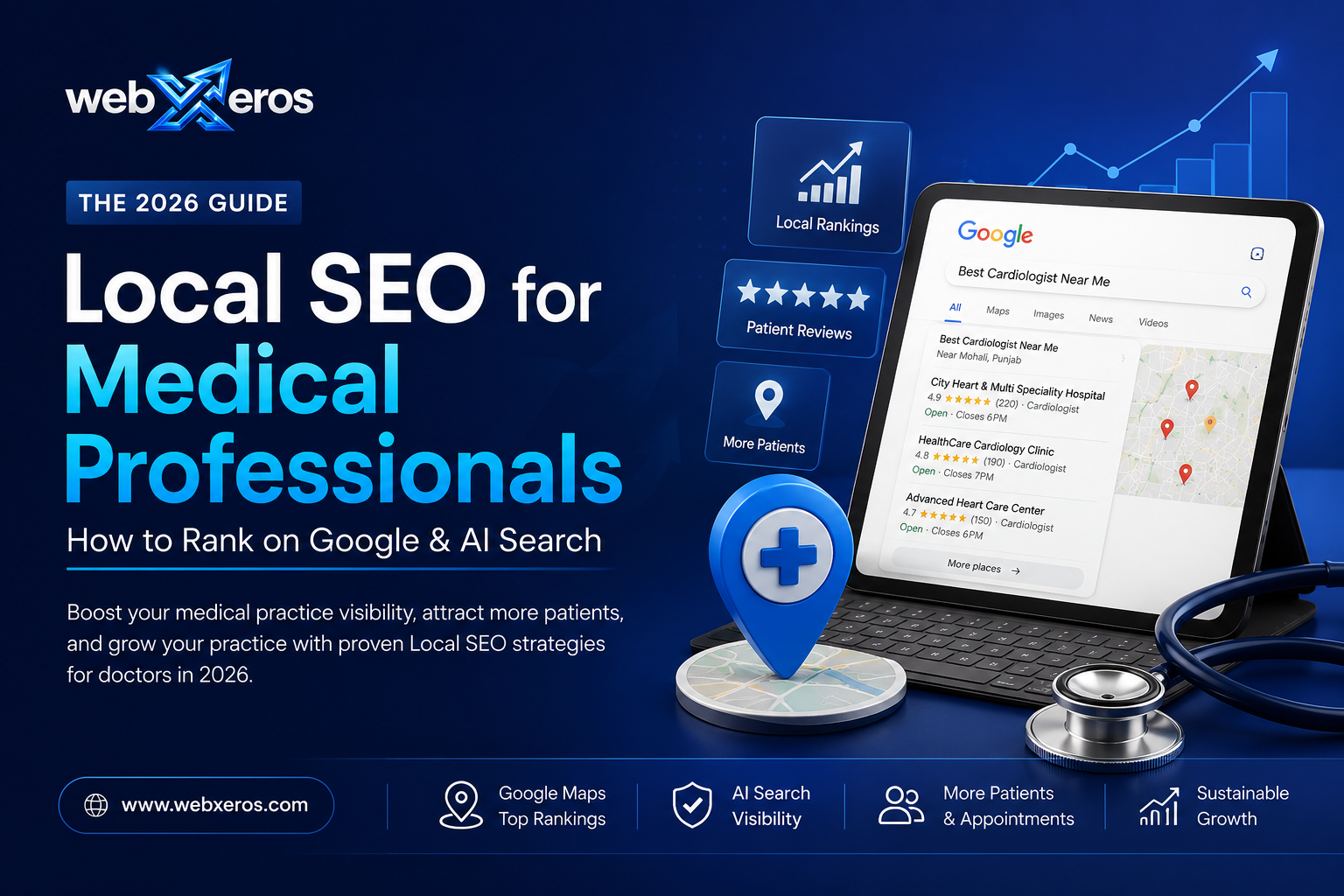
Direct answer: Local SEO for medical professionals is the practice of optimizing a doctor’s or clinic’s online presence Google Business Profile, website content, patient reviews, and citations so the practice appears when nearby patients search for care. In 2026, this means ranking across three systems at once: traditional organic results, the Google Maps local pack, and AI Overviews from Google, ChatGPT, Gemini, Claude, and Perplexity. Because health content falls under Google’s strictest quality standards (YMYL), medical practices need accurate NAP data, specialty-specific categorization, consistent reviews, and clear credentials to rank and, increasingly, to be cited by AI directly. This guide is brought to you by WebXeros Solutions, a digital marketing agency specializing in local SEO and AI-search visibility for medical practices across the US.
What Is Local SEO for Medical Professionals?
What it is: Local SEO for doctors is how your medical practice shows up when patients in your area search for healthcare providers online through Google Business Profile optimization, website content, patient reviews, local citations, and technical signals that tell Google exactly who you are, what you treat, and where.
Why it’s important: The majority of patients now search online before choosing a doctor. They compare reviews, check hours, look at photos, and evaluate credentials before ever calling. A practice that doesn’t appear in that search simply loses the patient to whichever provider did.
How it works: Google (and increasingly AI search engines) combine three ranking signals relevance (do you treat what the patient searched for), distance (how close you are), and prominence (reviews, citations, and overall online authority) to decide which practices to surface first.
Benefits: Consistent, compounding patient acquisition that doesn’t stop the moment you stop paying, unlike ads.
Challenges: Medicine faces a higher content-quality bar than almost any other industry, and HIPAA adds real constraints most other local businesses don’t face.
Best practice: Treat local SEO as infrastructure, not a campaign it needs continuous maintenance (fresh reviews, accurate listings, updated content), not a one-time setup.
Why Local SEO Matters More in Healthcare Than in Almost Any Other Industry
Approximately 77% of patients use search engines before booking a medical appointment, and roughly 80% of healthcare-related searches carry local intent, according to recent healthcare marketing industry data, meaning nearly every patient search for care is really a local search, whether or not it says so explicitly. (Editorial note: cite the original source study/report by name and link when publishing; per your site’s standard citation practice this strengthens the E-E-A-T signal further.)
This changes the stakes. A retail business losing a search ranking loses a sale. A medical practice losing visibility loses a patient relationship that could be worth thousands of dollars in lifetime value, and in some cases, means that patient delays or skips care altogether.
Key takeaway: If your practice isn’t visible at the moment a patient searches, you’re not just losing a click, you’re losing a person who needed care and found someone else instead.
The Three Systems You Now Have to Rank In
A patient’s search results today span three distinct systems, and each has different rules:
| System | What It Shows | What Ranks You There |
| Traditional organic listings | Blue links, service pages, blog content | Content depth, E-E-A-T, backlinks |
| Google Maps local pack | The 3-pack of nearby practices | Google Business Profile completeness, reviews, proximity |
| AI-generated answers | Summaries with source citations | Credibility signals, consistency across the web, structured answerable content |
Ignoring the third column in 2026 means ignoring how a growing share of patients now encounter health information before they ever reach a traditional search result. Practices cited as an AI source gain visibility and, increasingly, a ranking signal in traditional search too. Local SEO remains the foundation here AI visibility builds on the same trust signals rather than requiring a separate strategy.
Google Business Profile Optimization for Doctors: The Complete Checklist
What it is: Your Google Business Profile (GBP) is the single most important lever for local visibility it’s what populates the Maps local pack and heavily influences which practices AI systems reference.
Why it’s important: Google Maps visibility drives the highest-intent patient calls these are patients actively looking for a provider right now, not researching generally.
How it works: the foundational checklist
- Choose the most specific primary category for your specialty (Cardiologist, not just “Doctor”)
- Keep name, address, and phone number (NAP) identical across your website, GBP, and every directory
- Add accurate hours, insurance accepted, and languages spoken
- Upload real photos of your office, team, and credentials not stock images
- Collect reviews consistently, not in occasional bursts
- List every provider individually if you’re a multi-doctor practice
Advanced GBP optimization (often skipped, high-impact):
- Google Posts: Publish regular updates new services, health tips, seasonal reminders (flu shots, screenings) to keep the profile active, which Google treats as a freshness signal
- Q&A section: Proactively seed and answer common patient questions here rather than leaving it empty for strangers to fill in with guesses
- Services list: Fill in the dedicated Services section with specific, named procedures and treatments, not just a general specialty description this directly feeds which searches your profile surfaces for
- Appointment URL: Add a direct booking link so patients can schedule from the profile itself, reducing drop-off between “found you” and “booked”
Benefits: A fully optimized GBP is often the fastest-moving lever in medical SEO, sometimes showing ranking movement within weeks rather than months.
Challenges: Over-optimization (keyword-stuffing your business name, fake review bursts) can trigger Google penalties accuracy and consistency matter more than aggressive optimization.
Best practice: Audit your GBP quarterly for consistency drift insurance changes, new providers, or updated hours are common and easy to miss.
Patient Reviews, Reputation & HIPAA-Compliant Response Framework
What it is: Patient reviews are both a trust signal for patients and a prominence signal for Google and AI systems but they come with a compliance layer no other industry deals with.
Why it’s important: AI search platforms now evaluate credibility, consistency, and patient trust signals before recommending healthcare providers, and reviews are one of the clearest public trust signals available.
How it works: HIPAA doesn’t prohibit marketing, but it does govern how patient information is used in that marketing meaning you can and should respond to reviews, but never in a way that confirms someone was a patient or reveals details of their visit.
A safe response framework:
- Thank the reviewer generically, without confirming they were a patient
- Never discuss diagnosis, treatment, or visit specifics, even to correct a claim
- Invite them to contact the practice directly to discuss concerns
- For negative reviews: acknowledge, redirect offline, never argue publicly
Benefits: Consistent, compliant review management builds long-term trust signals that compound across both traditional search and AI citation.
Challenges: The instinct to “correct the record” publicly on a negative review is exactly what creates HIPAA exposure restraint is the compliant choice, even when it’s frustrating.
Best practice: Create a standard, pre-approved response template for your front-desk or marketing team so responses stay consistent and compliant regardless of who’s answering.
E-E-A-T for Medical Content: What Google (and AI) Actually Checks
What it is: E-E-A-T (Experience, Expertise, Authoritativeness, Trustworthiness) is Google’s framework for evaluating YMYL (Your Money or Your Life) content, and medical content sits at the center of that category.
Why it’s important: Your average competitor in the health content space is often a content farm with no real doctors on staff. Real board certifications and clinical experience are a genuine advantage, but only if that credibility is made visible on the page.
How it works: Google can’t read your diplomas; it reads your About page, author bios, credentials, and citations. The same is increasingly true of AI systems evaluating which sources to cite.
Trust signals to make visible:
- Named, credentialed authors on every medical content page (not “Admin” or “Staff”)
- Board certifications and years of practice stated clearly
- SSL certificate and a clear, accessible privacy policy
- Accurate, consistent contact information sitewide
Benefits: Strong, visible E-E-A-T signals are what separate a practice’s content from generic health content farms in both Google’s eyes and an AI system’s citation logic.
Best practice: Add a credentialed author byline and a short “Medically Reviewed By” line to every clinical content page, not just your About page.
AI Search Visibility: A Supporting Layer on Top of Strong Local SEO
What it is: AI answer engines synthesize responses from multiple sources, often with citations, meaning a practice can be recommended directly inside an AI-generated answer, without the patient ever clicking through to a website.
Why it’s important: This creates both a threat and an opportunity: some informational traffic gets absorbed into the AI summary itself, but practices cited as sources gain visibility and trust at the exact moment a patient is deciding.
How it works: AI platforms weigh credibility, consistency across the web, and patient trust signals the same. NAP consistency, review quality, and credential visibility that drives Google ranking also feed AI citation decisions. There’s no separate system to game here; it’s the same local SEO fundamentals, evaluated more rigorously.
Best practice: Don’t treat AI visibility as a separate project. Keep your GBP accurate, your information consistent across every directory, and your credentials visible; that same foundation is what earns citations in both Google and AI-generated answers over time.
Specialty Page Architecture: How Multi-Provider Clinics Should Structure Their Site
What it is: A well-structured medical SEO framework separates practice-level authority from specialty-specific pages, so a practice’s overall brand authority supports each specialty page without the pages competing against each other for the same rankings.
Why it’s important: For multi-service clinics, group practices, or healthcare networks, this separation improves indexing accuracy and lets each specialty rank independently while still reinforcing the broader medical brand behind it.
How it works:
- One strong practice/brand homepage establishing overall authority and credentials
- Individual specialty pages (e.g., /cardiology, /orthopedics) targeting specific specialty keywords
- Individual provider bio pages linking back to their specialty page
- Consistent internal linking between all three levels
Best practice: Avoid duplicating the same content across specialty pages each should address distinct patient questions, terminology, and decision timelines specific to that specialty.
What Local SEO for a Medical Practice Actually Costs in 2026
| Practice Type | Typical Monthly Investment | What It Covers |
| Small practice, moderate-competition market | $1,000 – $2,500/month | GBP optimization, basic content, review management |
| Specialist or major-metro practice | $3,000 – $6,000+/month | Full technical SEO, specialty content, advanced link building, AI visibility tracking |
The ROI math is direct: if a new patient generates $500–$5,000+ in lifetime value depending on specialty, acquiring just 3–5 new patients a month through organic search typically pays for the SEO investment several times over.
Best practice: Basic work, claiming your GBP listing, writing content, and requesting reviews can be done in-house. Advanced technical audits and ethical link building are usually worth contracting to a specialist, since mistakes here can risk penalties rather than gains.
Common Mistakes Medical Practices Make
- Treating GBP as a one-time setup instead of an ongoing, quarterly-audited asset
- Publishing generic blog content instead of specialty-specific, credentialed pages
- Responding to negative reviews in a way that reveals or implies clinical details
- Ignoring AI Overview visibility entirely, assuming Google’s classic results are the only channel that matters
- Relying exclusively on paid ads instead of building the organic and AI-citation foundation that compounds over time
- Adding more blog content as a fix for a trust problem, when the real fix is improving precision, credibility signals, and review consistency on existing pages
Key Takeaways
- Local SEO for medical professionals now means ranking across three systems at once: organic search, the Google Maps local pack, and AI Overviews.
- Roughly 77% of patients search online before booking, and 80% of healthcare searches carry local intent local visibility is not optional for any practice with a physical location.
- Google Business Profile remains the single strongest local ranking lever accuracy and consistency matter more than aggressive optimization.
- HIPAA doesn’t block marketing, but it strictly limits what you can say when responding to reviews or referencing patient encounters.
- AI platforms like ChatGPT, Gemini, Claude, and Perplexity reward the same core trust signals as Google there’s no separate shortcut, only more rigorous evaluation of the same credibility markers.
- Realistic budgets run $1,000–$6,000+/month depending on practice size and market competitiveness; the ROI is straightforward given patient lifetime value.
Getting Help With Local SEO for Your Practice
Some practices handle the basics in-house, claiming a GBP listing, requesting reviews, and writing a few pages of content. Others, especially specialists or multi-provider clinics in competitive metro markets, bring in a dedicated team to handle the technical audits, compliant content structure, and ongoing AI-visibility tracking this guide covers.
WebXeros Solutions works with medical practices across the US on exactly this local SEO, HIPAA-aware content, and structuring a practice’s online presence so it’s visible not just on Google but in the AI answers patients are increasingly relying on.
Get a free Medical Local SEO audit; we’ll review your Google Business Profile, check for NAP consistency issues across directories, and give you a prioritized checklist of what to fix first. Book your free audit
Lorem ipsum dolor sit amet, consectetur adipiscing elit. Ut elit tellus, luctus nec ullamcorper mattis, pulvinar dapibus leo.
What is local SEO for medical professionals?
Local SEO for medical professionals is the process of optimizing a practice’s Google Business Profile, website, reviews, and citations so it appears when nearby patients search for care across traditional Google results, the Maps local pack, and AI-generated answers.
Why does local SEO matter more for doctors than most industries?
About 77% of patients search online before booking an appointment, and 80% of healthcare searches carry local intent, while Google holds medical content to its strictest quality standards (YMYL), making visibility and credibility both harder and more critical to get right.
How does Google Business Profile affect a doctor's ranking?
GBP is the primary driver of Google Maps local pack visibility, the highest-intent placement for patient calls. Accuracy, correct specialty categorization, and consistent reviews matter more than aggressive optimization tactics.
Is medical SEO HIPAA-compliant?
Yes, when done correctly. HIPAA doesn’t prohibit marketing, but it governs how patient information is used, meaning practices can market and respond to reviews, but must never confirm patient identity or reveal clinical details publicly.
How much does local SEO cost for a medical practice?
Typical costs range from $1,000–$2,500/month for smaller practices in moderate-competition markets, up to $3,000–$6,000+/month for specialists or practices in major metro areas, with ROI generally justified by patient lifetime value.
How do AI overviews and ChatGPT choose which doctors to recommend?
AI platforms evaluate credibility, consistency of information across the web, and patient trust signals largely the same. Google uses it for traditional rankings, evaluated with added scrutiny given healthcare’s YMYL status.